
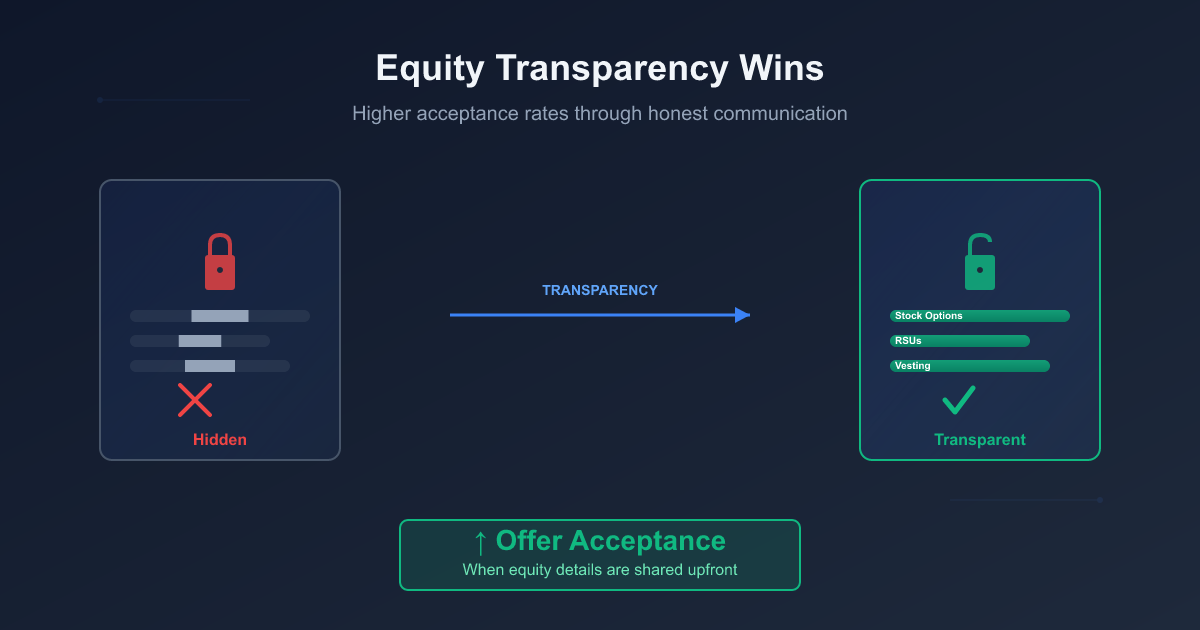
Why Transparency About Equity Actually Increases Acceptance
Key Takeaways: - 84% of job seekers prefer listings that include salary ranges (beqom) - 70% of candidates choose jobs based on transparency practices (Gartner) - DataGrail achieved 89.7% offer acceptance with transparent equity disclosure - Stock options vs RSUs: options give the right to buy at a fixed price; RSUs are shares that vest automatically - Pay transparency laws in CA, CO, NY require salary range disclosure; proactive equity disclosure is a competitive advantage
There's a pervasive fear among startup founders when it comes to equity compensation:
"If we're too transparent about our equity, candidates will negotiate harder."
"If we show them the numbers, they'll focus on the risks."
"If we explain the complexity, they'll just get confused and walk away."
So what do most startups do? They offer equity in the vaguest possible terms:
"We're offering you 10,000 stock options."
No context. No explanation. No valuation. Just a number floating in space.
Here's the irony: this lack of transparency is exactly what's causing candidates to decline offers or heavily discount the equity value.
Transparency about equity doesn't hurt you, it helps you. Companies that are upfront about compensation, including equity, see significantly higher offer acceptance rates.
Let's dig into why.
The Transparency Paradox
Conventional wisdom suggests that the less you tell candidates, the better your negotiating position. This might have been true in 2010, but it's dead wrong in 2025.
Consider these statistics:
- 84% of job seekers are more likely to apply if the job description lists a salary range
- 70% of candidates would choose one job over another based on the organization's transparency practices
- 60% of US employees would switch jobs for more pay transparency than their current company provides
Transparency isn't just a nice-to-have. It's a competitive differentiator.
And this extends directly to equity compensation. When startups fail to explain equity clearly, candidates don't negotiate less. They simply discount the equity to zero and compare offers based purely on base salary.
You're not protecting your negotiating position. You're making your offer look worse than it actually is.
What Happens When Equity Isn't Transparent
Let's walk through a typical scenario:
Startup offers: $130,000 salary + 10,000 stock options
Candidate receives: A PDF that says "10,000 stock options, 4-year vesting with 1-year cliff"
Candidate thinks: "What does this actually mean? What are these options worth?"
They Google "how to value startup stock options" and find conflicting advice: - "Options are worthless until the company goes public" - "Multiply options by the strike price to estimate value" - "Assume 10x dilution over time" - "Only count equity from post-Series B companies"
Overwhelmed and confused, the candidate does one of two things:
- Ignores the equity entirely and compares offers based purely on salary
- Emails you with 10 questions about vesting, valuation, tax implications, and dilution
If they ignore the equity, your $130k + equity offer now looks worse than a competitor's $140k + no equity offer—even though your total compensation is likely higher.
If they email you with questions, you're now spending hours explaining concepts like 409A valuations, ISOs vs NSOs, and early exercise—probably over several email exchanges and phone calls.
Either way, you lose.
What Transparency Actually Looks Like
Contrast that scenario with this one:
Startup offers: $130,000 salary + 10,000 stock options
Candidate receives: An interactive offer showing:
- Equity grant: 10,000 stock options
- Current valuation: $5.00/share (based on most recent 409A)
- Strike price: $0.50/share (the price you pay to exercise)
- Potential value (pre-tax): $45,000 if exercised today
- Vesting schedule: Visual chart showing how equity unlocks over 4 years
- Ownership percentage: 0.05% of the company
- What this means: Clear explanation of how options work, tax implications, and potential scenarios
Candidate thinks: "I understand exactly what I'm getting. This equity could be worth $45,000+ if the company succeeds. That makes the total offer competitive."
The candidate can now compare your offer accurately against others. And when candidates understand what they're getting, they value it properly.
The Data Doesn't Lie
Let's look at real-world examples of what happens when companies embrace transparency:
DataGrail: 89.7% Offer Acceptance Rate
DataGrail implemented market-rate pay and transparency practices across their compensation strategy. Their offer acceptance rate climbed to 89.7%—well above the industry average of 69-73%.
Candidates viewed the company's transparent approach to pay as a sign of a trustworthy culture. The transparency itself became a selling point.
The 70% Rule
According to Gartner research, nearly 70% of employees would take one job offer over another based on the organization's transparency practices.
This isn't about offering more money. It's about being upfront about the money you're already offering.
Two identical offers—same salary, same equity, same benefits—but one is presented transparently and the other isn't. The transparent offer wins 70% of the time.
Pay Transparency as a Top-3 Recruiting Trend
In a 2024 survey of recruiting professionals, 53% ranked pay transparency as one of the three most important trends for the future of recruiting—alongside soft skills and work flexibility.
This isn't a fringe movement. It's mainstream.
Why Transparency Works: The Psychology
There are several psychological reasons why transparency about equity increases acceptance:
1. It Builds Trust
When you're upfront about compensation details, you signal that you have nothing to hide. Candidates interpret this as a sign of a healthy, trustworthy company culture.
If you're transparent about equity, candidates assume you'll be transparent about everything else: company challenges, growth trajectory, career development, and performance expectations.
Conversely, if you're vague or secretive about equity, candidates wonder: "What else are they hiding?"
2. It Reduces Cognitive Load
Evaluating job offers is mentally exhausting, especially when comparing multiple offers with different compensation structures.
When one company makes this easy (clear breakdown, visual aids, simple explanations) and another makes it hard (vague details, complex jargon, no context), candidates gravitate toward the easier option.
Transparency reduces decision fatigue. And when candidates aren't exhausted trying to decode your offer, they're more likely to say yes.
3. It Properly Values Your Offer
This is the big one: when candidates don't understand equity, they undervalue it or ignore it entirely.
Imagine you're offering $130k salary + $50k/year in equity value. That's effectively a $180k total compensation package.
But if the candidate doesn't understand the equity, they mentally treat your offer as $130k—and compare it against a competitor offering $145k with no equity.
You just lost a candidate not because your offer was worse, but because the candidate couldn't understand it.
Transparency ensures candidates value your offer correctly.
4. It Preempts Questions and Speeds Up Decisions
When your offer includes comprehensive equity explanations, candidates don't need to email you with follow-up questions.
They can share the offer with a spouse or advisor who can also understand it immediately. Decisions happen faster.
Speed matters in hiring. The faster a candidate can evaluate and accept your offer, the less time they have to receive competing offers or develop cold feet.
Common Objections (And Why They're Wrong)
Let's address the most common pushbacks to equity transparency:
Objection #1: "If we show our valuation, candidates will negotiate harder"
Reality: Candidates are already Googling your valuation. If you've raised funding, your 409A valuation is often available through sources like Carta, Crunchbase, or industry networks.
By being upfront, you control the narrative. You can explain why the valuation is what it is and what the upside potential looks like.
If you hide it, candidates will either: - Find it anyway and wonder why you weren't transparent - Assume the worst case scenario - Discount the equity to zero
Objection #2: "Equity is too complicated to explain simply"
Reality: Equity is complicated, but that's exactly why you need to explain it clearly.
If your own team can't explain equity in simple terms, how can you expect candidates to understand and value it?
The solution isn't to avoid the complexity—it's to break it down: - Use visual aids (vesting schedules shown as charts) - Provide scenarios (best case, worst case, likely case) - Explain key terms in plain language - Offer calculators or interactive tools
Candidates don't need to become equity experts. They just need to understand what they're getting and why it's valuable.
Objection #3: "Other companies don't do this, so we don't need to either"
Reality: Most companies are bad at explaining equity. If you do it well, you have a competitive advantage.
Remember: 70% of candidates prefer the more transparent offer when everything else is equal.
If your competitors are being vague and you're being crystal clear, you win.
Objection #4: "What if our equity isn't worth much? Transparency will hurt us."
Reality: If your equity truly isn't valuable, then you need to compete on other dimensions—salary, benefits, mission, growth opportunities, culture.
But hiding that your equity isn't valuable won't help you. Candidates will figure it out eventually (either during diligence or after they join), and you'll lose trust.
Transparency forces you to be honest about what you're offering and to compete on your actual strengths.
How to Implement Equity Transparency
If you're convinced that transparency helps (and the data says it does), here's how to implement it:
1. Include These Details in Every Equity Offer
At minimum, your offer should include:
- Number of options/RSUs granted
- Type of equity (ISO, NSO, RSU, etc.)
- Strike price (for options) or grant price (for RSUs)
- Current 409A valuation (for private companies)
- Ownership percentage (e.g., 0.05% of the company)
- Vesting schedule (with visual representation)
- Cliff period (e.g., 1-year cliff)
- Expiration timeline (for options)
2. Provide Context and Scenarios
Don't just list numbers—explain what they mean:
- What's the potential value? Show scenarios: current value if exercised today, potential value if the company grows 3x, 5x, 10x
- How does vesting work? Use visual charts showing equity unlocking over time
- What happens if I leave? Explain post-termination exercise windows
- What are the tax implications? Provide high-level guidance (or link to resources)
3. Make It Visual
Text-heavy explanations lose people. Use: - Vesting schedule charts - Total compensation breakdowns (pie charts showing salary + equity + benefits) - Scenario modeling tables - Comparison tools (if appropriate)
4. Include FAQs
Anticipate questions and answer them proactively:
- "How is the 409A valuation determined?"
- "What's the difference between ISOs and NSOs?"
- "What happens to my equity if the company is acquired?"
- "How do I exercise my options?"
- "What is dilution and how does it affect me?"
5. Make It Easy to Share
Candidates often want to discuss offers with partners, family, or advisors. Make your offer easy to share and understand by non-experts.
An interactive, web-based offer is far more shareable than a static PDF filled with jargon.
Real-World Example: The Transparent Offer
Here's what a transparently structured equity section looks like:
Your Equity Compensation
You're being granted 10,000 stock options in [Company Name].
What does this mean?
Stock options give you the right to purchase shares of our company at a fixed price (called the "strike price"). If the company grows and the shares become more valuable, you can buy them at the lower strike price and benefit from the difference.
Your Grant Details:
- Grant: 10,000 stock options
- Strike price: $0.50 per share (this is what you pay to buy the shares)
- Current 409A valuation: $5.00 per share (our company's current estimated value per share)
- Current potential value (pre-tax): $45,000 if you exercised today ($5.00 - $0.50 = $4.50 profit per share × 10,000 shares)
- Ownership: ~0.05% of the company
Vesting Schedule:
Your options vest over 4 years with a 1-year cliff: - Year 1 (cliff): 2,500 options (25%) vest on your 1-year anniversary - Years 2-4: 208 options vest monthly (remaining 75% over 36 months)
[Insert visual chart showing vesting over time]
What's the upside?
If our company grows, your equity becomes more valuable. Here are some scenarios:
| Company Valuation | Value per Share | Your Potential Value (pre-tax) | |-------------------|-----------------|-------------------------------| | Current ($100M) | $5.00 | $45,000 | | 3x growth ($300M) | $15.00 | $145,000 | | 5x growth ($500M) | $25.00 | $245,000 | | 10x growth ($1B) | $50.00 | $495,000 |
Note: These are hypothetical scenarios for illustration only. Actual outcomes depend on many factors including company performance, dilution, and market conditions.
Common Questions:
- What happens if I leave before 4 years? You keep any vested options and typically have 90 days to exercise them.
- Do I have to pay anything? You pay the strike price ($0.50/share) when you exercise your options.
- What about taxes? Exercising options can trigger tax obligations. We recommend consulting a tax advisor.
[Link to comprehensive equity FAQ]
This is transparency. Every key detail is included, explained simply, and visualized clearly.
The Competitive Advantage
Here's the opportunity: most startups are still terrible at explaining equity.
They send vague offer letters, field dozens of follow-up questions, and lose candidates who don't understand what they're being offered.
If you implement transparency—clear explanations, visual aids, proactive FAQ answers—you instantly stand out.
You're not just offering equity. You're making it easy for candidates to understand and value what you're offering.
And when candidates can easily understand your offer, they're more likely to accept it.
The Bottom Line
The fear that transparency will hurt you is unfounded. The data consistently shows the opposite:
- 89.7% offer acceptance rate when transparency is implemented (DataGrail)
- 70% of candidates prefer transparent offers over non-transparent ones (Gartner)
- 84% of candidates want salary ranges listed upfront
- 53% of recruiters rank transparency as a top-3 trend for hiring
Transparency about equity doesn't weaken your negotiating position—it strengthens your offer by ensuring candidates understand and properly value what you're giving them.
In a competitive hiring market where candidates are comparing multiple offers, clarity is a competitive advantage.
The startups that win top talent aren't the ones hiding details. They're the ones being radically transparent about compensation, equity, and culture.
Be one of them.
Want to make your equity offers crystal clear? ClearOffer helps startups create transparent, visual, interactive offers that candidates actually understand. Try it free today.
Frequently Asked Questions
Should I disclose equity details in the job offer?
Yes. Research consistently shows that transparency about equity increases offer acceptance rates — companies implementing pay and equity transparency report acceptance rates of 89.7% compared to the 69–73% industry average. Candidates who understand their equity are more likely to value it and less likely to discount it to zero.
How do I explain stock options to candidates?
Break it down into four components candidates care about: (1) the number of shares and what percentage of the company they represent, (2) the strike price vs. the current fair market value, (3) the vesting schedule (typically 4 years with a 1-year cliff), and (4) a realistic range of potential outcomes based on different valuation scenarios. Visual aids like vesting timelines and equity calculators make this significantly clearer.
What is the difference between stock options and RSUs?
Stock options give employees the right to buy company shares at a fixed price (the strike price). They have value only if the company's value exceeds the strike price. RSUs (Restricted Stock Units) are grants of actual shares that vest over time — they always have value as long as the company has value. Startups typically offer stock options (ISOs or NSOs), while later-stage companies and public companies more commonly offer RSUs.
Do pay transparency laws require disclosing equity?
It depends on the jurisdiction. California, Colorado, New York, and several other states require salary ranges in job postings, and some require disclosure of total compensation including equity and benefits when requested. Regardless of legal requirements, proactively disclosing equity details in offers is a competitive advantage — 70% of candidates prefer transparent offers according to Gartner research.
How does equity transparency affect negotiation?
Contrary to common fears, equity transparency doesn't weaken your negotiating position. When candidates understand the full value of what you're offering — including equity projections — they're less likely to counter-offer based on base salary alone. Transparency shifts the conversation from "I need more cash" to "I understand the total value of this package."
Sources and Data
-
beqom. "Job Seekers Prefer Transparency and Pay Equity." beqom Research, 2022. https://www.beqom.com/resources/job-seekers-prefer-transparency-and-pay-equity (84% of job seekers more likely to apply with salary ranges listed, 70% would choose based on transparency practices, 60% would switch for more pay transparency)
-
Gartner Research. "Pay Transparency as a Recruiting Trend." Gartner, 2024. https://www.gartner.com/en/human-resources/insights/pay-transparency (70% of candidates prefer transparent offers, 53% of recruiters rank transparency as top-3 trend)
-
DataGrail. "Pay Equity and Transparency Case Study." DataGrail, 2024. https://www.datagrail.io/resources/case-studies/pay-equity-transparency (89.7% offer acceptance rate with transparency implementation)
-
CareerPlug. "2024 Candidate Experience Statistics." CareerPlug, 2024. https://www.careerplug.com/candidate-experience-statistics/ (Additional transparency and candidate experience data)