
Why 31% of Candidates Decline Your Offer (And What's Really Happening)
Key Takeaways: - The average job offer acceptance rate is 69-73%, meaning 27-31% of candidates decline (NACE) - Candidates are 66% more likely to decline than before the pandemic - Top decline reasons: negative interview experience (36%), poor communication (26%), competing offers - Companies with transparent offer practices see acceptance rates above 85% - Each declined offer costs $5,000-$15,000+ in re-hiring costs
You did everything right.
You sourced the perfect candidate, conducted thorough interviews, aligned internally on compensation, and extended a competitive offer. You're excited. Your team is excited.
Then the candidate says no.
According to recent data, out of every 100 job offers extended, 31 candidates decline. That's nearly one in three.
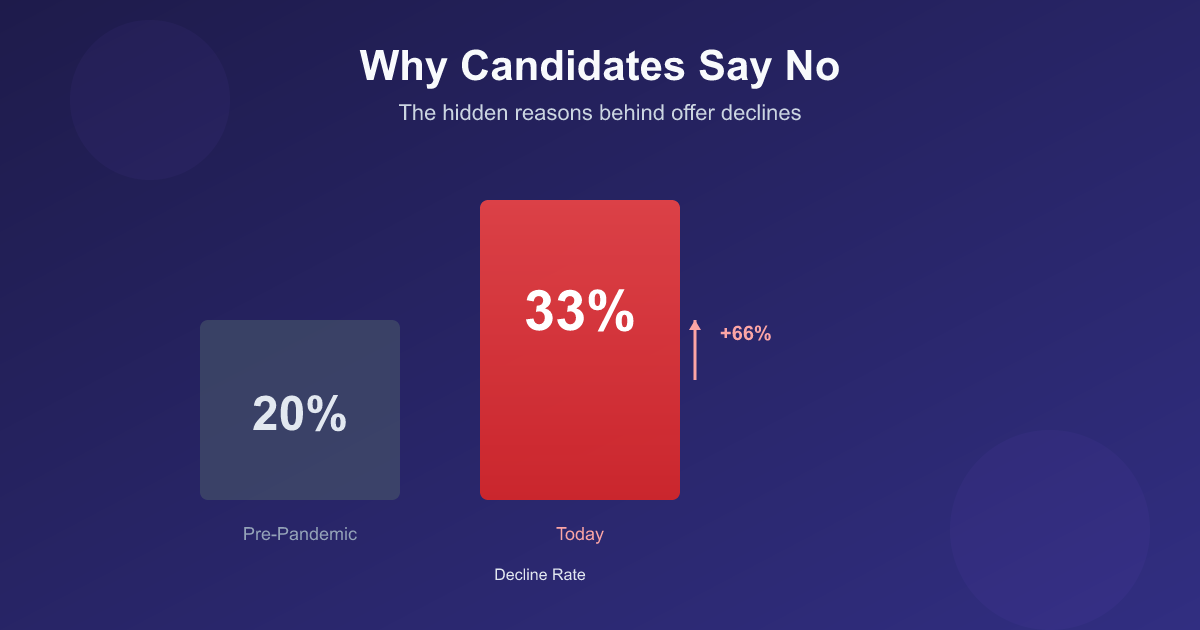
Even more striking: candidates today are 66% more likely to decline an offer than they were before the pandemic. Something fundamental has shifted in how candidates evaluate and accept job offers.
If you're a hiring manager at an early-stage startup, these statistics should worry you. When you're hiring 10-20 people per year, a 31% decline rate means you're losing 3-6 great candidates—people you already invested weeks recruiting and interviewing.
But here's the thing: most offer declines are preventable.
Let's dig into what the data actually reveals about why candidates say no, and more importantly, what you can do about it.
The Numbers Don't Lie
First, let's establish the baseline. The average offer acceptance rate across industries hovers around 69-73%, which translates to a 27-31% decline rate.
But this varies significantly by industry:
- Professional and technical industries (business services, finance, IT): 19.4% decline rate
- Healthcare, retail, and food service: 14.8% decline rate
- All industries average: 27-31% decline rate
If your startup operates in tech or professional services, you're facing steeper odds—nearly one in five candidates will decline.
And if your acceptance rate falls below 70%, you're in the red zone. According to recruiting benchmarks, anything below 70% signals serious problems with your hiring process or offers.
The Top Reasons Candidates Decline Offers
Research reveals several consistent patterns. Here's what's actually driving candidates to say no:
1. Poor Communication and Unclear Expectations (26% Decline Due to This)
According to 2024 candidate experience data, 26% of job seekers declined offers specifically because of poor communication or unclear job expectations during the hiring process.
This isn't about the offer itself—it's about everything leading up to it:
- Vague job descriptions
- Inconsistent messaging from different interviewers
- Unclear growth paths or role expectations
- Lack of transparency about company challenges
- Slow or sparse communication during the process
When candidates don't feel like they understand what they're signing up for, they walk away—even from good offers.
Real-world example: A candidate interviewed for a "Product Manager" role at a Series A startup. Different interviewers described wildly different responsibilities. One said it was 80% strategy. Another said 80% execution. The offer was competitive, but the candidate declined because they couldn't figure out what the job actually entailed.
2. Negative Interview Experiences (36% Decline Due to This)
Here's an even more sobering statistic: 36% of candidates declined offers because of negative interactions during interviews.
This includes: - Disrespectful or dismissive interviewers - Unprepared interviewers who hadn't reviewed the resume - Overly aggressive or inappropriate questions - Poor communication about interview process or next steps - Cultural red flags during conversations
Think about that for a moment: more than one in three candidates are declining offers not because of compensation or role fit, but because the interview experience turned them off.
Your interview process isn't just evaluation—it's selling. And if you're not treating it that way, you're losing candidates before you even get to the offer stage.
3. Compensation Confusion and Lack of Transparency
This is where startup offers often fall apart.
When candidates receive offers from multiple companies, they compare total compensation. But if your offer is unclear, confusing, or lacks transparency, candidates either:
- Undervalue your offer (because they don't understand it)
- Get frustrated (because they can't easily compare)
- Assume the worst (if you're hiding details, what else are you hiding?)
For startups offering equity compensation, this problem is amplified. Consider this scenario:
Company A: "We're offering $140,000 salary + 10,000 stock options with a 4-year vest and 1-year cliff. Our current 409A valuation is $5/share."
Company B: "We're offering $150,000 salary + 5,000 RSUs vesting over 4 years."
Which offer is better? Most candidates can't easily tell. And if they can't figure it out quickly, they default to the higher salary or the offer that's easier to understand.
Research from 2024 shows that 84% of job seekers want salary ranges listed in job descriptions, and 70% of candidates would choose one job over another based on the organization's transparency practices.
Transparency isn't just nice-to-have—it's a competitive advantage.
4. Equity Confusion (The Startup-Specific Problem)
For tech startups, equity is often 30-50% of total compensation. But most candidates don't understand:
- Stock options vs RSUs vs profit sharing
- How vesting schedules work
- What a 409A valuation means
- How to value pre-IPO equity
- What happens if they leave before fully vested
- The tax implications of exercising options
When candidates don't understand their equity, they either: - Discount it entirely (treating it as worth $0) - Ask you to explain it multiple times - Spend hours researching online and getting confused by conflicting information - Decline the offer in favor of something simpler
According to conversations with startup recruiters, equity questions account for 40-50% of all candidate follow-up conversations during the offer stage. For technical roles, this often balloons into multiple hour-long phone calls.
If your candidates don't understand their equity, they won't value it. And if they don't value it, your offer looks less competitive than it actually is.
5. Competing Offers and Decision Fatigue
In a competitive hiring market, strong candidates often receive multiple offers simultaneously.
When comparing offers, candidates are building spreadsheets, talking to advisors, and weighing dozens of factors: - Salary - Equity - Benefits - Commute/remote flexibility - Company stage and growth potential - Team culture - Learning opportunities - Work-life balance
If your offer is presented as a static PDF while competitors are providing interactive, clear breakdowns, you're at a disadvantage.
Decision fatigue is real. The easier you make it for candidates to understand and evaluate your offer, the more likely they are to say yes.
6. Lack of Urgency or Excitement
Sometimes candidates decline not because there's anything wrong with the offer, but because they're just not excited enough.
This often happens when: - The offer feels impersonal (generic template with no personalization) - There's a long gap between final interview and offer - The offer doesn't remind them why this role is special - They don't feel connected to the mission or team
Momentum matters. If a candidate finishes their interview excited and receives an offer three days later while that excitement is still fresh, they're more likely to accept. If the offer comes two weeks later, the emotional connection has faded.
What You Can Actually Control
Here's the good news: most of these decline reasons are preventable. You can't control competing offers or a candidate's personal circumstances, but you can control:
1. Your Interview Process
Action items: - Train interviewers on how to sell the role and company (not just evaluate) - Be transparent about challenges and expectations - Ensure consistent messaging across all interviewers - Communicate promptly and keep candidates informed - Make the process feel personal and respectful
Impact: Reduces declines due to negative interview experiences (the 36% problem)
2. Your Offer Clarity
Action items: - Show total compensation clearly (salary + equity + benefits) - Explain equity in simple terms with visual aids - Include FAQs for common questions - Make benefits easy to understand - Provide comparison tools or calculators
Impact: Reduces declines due to confusion and helps candidates value your offer correctly
3. Your Transparency
Action items: - Be upfront about salary ranges early in the process - Explain equity value and vesting honestly - Discuss company trajectory and risks openly - Share compensation philosophy
Impact: Builds trust and helps candidates feel confident in their decision
4. Your Speed and Momentum
Action items: - Move quickly from final interview to offer (ideally 24-48 hours) - Keep candidates engaged during the decision period - Personalize offers with specific reasons you're excited about them - Create urgency without being pushy
Impact: Captures candidates while they're excited and before competing offers materialize
The Cost of Doing Nothing
Let's talk about what a 31% decline rate actually costs you.
Imagine your startup is hiring 15 people this year. With a 31% decline rate, that means:
- 4-5 candidates will decline your offers
- Each declined offer represents 20-40 hours of recruiting work (sourcing, screening, interviewing, internal alignment)
- Total wasted time: 80-200 hours per year
That's 2-5 weeks of full-time recruiting effort going to waste.
But it's worse than that. Every declined offer means: - Delayed hiring (time-to-fill increases) - Lost momentum with second-choice candidates - Team frustration and burnout - Missed opportunity costs (what could that hire have built?)
For an early-stage startup trying to hit aggressive growth goals, every lost hire matters.
What High-Performing Teams Do Differently
Companies with acceptance rates above 85% (well above the 69-73% average) share common practices:
They Optimize the Entire Candidate Journey
Great offers don't exist in isolation. They're the culmination of a positive candidate experience from the first touchpoint through day one.
High-performing teams: - Respond to applications quickly - Communicate transparently throughout the process - Train interviewers on selling, not just evaluating - Gather feedback and continuously improve
They Make Offers Crystal Clear
Top teams use visual aids, interactive breakdowns, and self-service resources to ensure candidates fully understand offers without requiring multiple email exchanges.
Examples: - Visual vesting schedules showing equity value over time - Total compensation calculators - Benefits comparison charts - FAQ sections addressing common concerns
They Move Fast
Speed matters. The best teams make offers within 24-48 hours of a final interview while the candidate's excitement is at its peak.
They also use engagement data (if available) to understand when to follow up and which parts of the offer candidates are spending time on.
They Build Trust Through Transparency
Instead of treating compensation as a negotiation to be won, high-performing teams treat it as a conversation to be had.
They're upfront about: - Compensation philosophy - How they benchmark roles - Why equity is structured the way it is - Company financial health and fundraising plans
This transparency builds trust and makes candidates feel confident in their decision.
The Action Plan: Reducing Your Decline Rate
If your offer acceptance rate is below 70%, here's how to improve it:
Week 1: Audit Your Current Process
- Track your last 10-20 offers: how many were accepted vs declined?
- Survey or interview candidates who declined (ask why honestly)
- Review your offer templates: are they clear? Comprehensive? Engaging?
- Assess your interview process: are you selling effectively?
Week 2-3: Fix the Biggest Gaps
Focus on your #1 problem:
If candidates are declining due to interview experience: → Train your interviewers and establish consistent messaging
If candidates are declining due to confusion: → Redesign your offers to be clearer and more visual
If candidates are declining due to lack of transparency: → Add salary ranges to job posts and be more open about compensation
Week 4+: Implement and Measure
- Roll out improvements to your next offers
- Track acceptance rate improvement
- Gather feedback from candidates (both acceptances and declines)
- Iterate based on results
Target: Improve your acceptance rate by 10-15 percentage points within 3 months
The Bottom Line
A 31% decline rate is the industry average, but it doesn't have to be your reality.
Most offer declines stem from preventable issues: - Poor communication and unclear expectations - Negative interview experiences - Confusion about compensation and equity - Lack of transparency - Weak momentum and urgency
By addressing these root causes—through better interview processes, clearer offers, transparency, and speed—you can significantly improve your acceptance rate.
Every percentage point improvement in acceptance rate translates to real outcomes: fewer wasted hours, faster team growth, and stronger talent acquisition.
For early-stage startups where every hire matters, reducing your decline rate isn't just a nice-to-have. It's a competitive advantage.
Want to make your equity offers crystal clear? ClearOffer helps startups create transparent, visual, interactive offers that candidates actually understand. Try it free today.
Frequently Asked Questions
What is the average offer acceptance rate?
The average job offer acceptance rate across all industries is approximately 69–73%, meaning roughly 27–31% of candidates decline. This rate varies significantly by industry and has increased since the pandemic — candidates are now 66% more likely to decline than they were before 2020.
Why do candidates decline job offers?
The most common reasons candidates decline offers are: competing offers with better compensation (the #1 factor), unclear or confusing offer details, poor communication during the hiring process, negative interview experiences, and lack of transparency about equity or total compensation. Many of these are preventable with a better offer process.
How can I improve my offer acceptance rate?
Focus on three high-impact areas: (1) speed — extend offers within 24–48 hours of final interviews, (2) clarity — present total compensation visually so candidates understand base salary, equity, bonuses, and benefits at a glance, and (3) transparency — proactively explain equity details, vesting schedules, and company valuation context rather than waiting for candidates to ask.
What is a good offer acceptance rate for startups?
A good target for early-stage startups is 80–90%+ acceptance rate. The industry average of 69–73% means there's significant room for improvement. Startups that present clear, transparent offers with well-explained equity typically outperform the average by 15–20 percentage points.
How much does a declined offer actually cost?
A single declined offer can cost $5,000–$15,000+ when you factor in recruiter time, extended role vacancy, team productivity loss, and restarting the search. For startups hiring 10–20 people per year, a 31% decline rate means 3–6 lost candidates — potentially $30,000–$90,000 in wasted resources annually.
Sources and Data
-
CareerPlug. "2024 Candidate Experience Statistics." CareerPlug, 2024. https://www.careerplug.com/candidate-experience-statistics/ (26% of candidates decline due to poor communication or unclear expectations)
-
National Association of Colleges and Employers (NACE). "As Offer Rate Climbed, Acceptance and Early Retention Rates Fell." NACE, 2023. https://www.naceweb.org/talent-acquisition/trends-and-predictions/calculating-and-using-interview-to-offer-offer-to-acceptance-rates (69-73% average acceptance rate, 27-31% decline rate)
-
Withe. "10+ Job Offer Statistics [2024]." Withe Blog, 2024. https://withe.co/blog/job-offer-statistics (Industry offer acceptance and decline rate data)
-
Ashby. "Offer Acceptance Rates | Talent Trends Report." Ashby, 2023. https://www.ashbyhq.com/talent-trends-report/reports/2023-trends-report-offer-acceptance-rates (Offer acceptance rate trends and benchmarks)
-
Toggl. "Average Job Offer Acceptance Rate & Tips for Increasing Yours." Toggl Blog. https://toggl.com/blog/job-offer-acceptance-rate (Acceptance rate benchmarks and industry data)